


Esther De Berdt Reed: The Revolutionary Woman Who Didn’t Wait for Permission

Updated: Feb 21

How a military wife turned the Revolutionary War upside down — with a pen, a plan, and a whole lot of linen.
Image: Esther De Berdt Reed, 1848, The women of the American Revolution / by Elizabeth F. Ellet v. 1

Quick note: this is Part 2: How America's earliest military wives turned conviction into collective action — and demonstrated how women could mobilize political action in support of the war effort — one spinning wheel at a time. Because this isn't just history — it's the origin story of military spouse history.
The Revolutionary We Forgot to Mention
When we picture the American Revolution, we usually imagine the big names — Washington, Adams, Hamilton, dramatically singing on a Broadway stage, and now Ken Burns’ documentary on the era. But tucked between the battles and political drama was Esther de Berdt Reed, Pennsylvania's First Lady and the founder of the Ladies’ Association of Philadelphia. She was a sharp-minded, British-born military wife who refused to sit quietly while history unfolded.

In 1780, she wrote a political broadside so bold that she signed it “An American Woman,” as if daring anyone to underestimate her. Although printed anonymously, the document is widely credited to Esther de Berdt Reed.
Before Esther ever put ink to paper, she had already survived the Revolution in a far more personal way. During the British occupation of Philadelphia in 1777–78, she and her children were forced to flee the city as refugees.
Nothing sharpens a woman’s sense of political stakes quite like being driven from her home.
That experience — the fear, the uncertainty, the sense of everything slipping away — helps explain the fierce intensity and commitment that fueled her activism in the years that followed.
A Pamphlet That Declared Women Were In the Revolution
In 1780, Esther helped launch the Ladies’ Association of Philadelphia with the publication of a broadside titled The Sentiments of an American Woman. It wasn’t a recipe. It wasn’t embroidery patterns. It wasn’t “oh, poor us.” It was a rallying cry — a political and fundraising campaign rolled into one.

Esther declared that women were every bit as patriotic as the men fighting in the fourth year of the war. (Yes, this was scandalous — yes, she knew it.) She urged women to give up their luxuries and donate their savings to support the Continental Army. And women showed up. They answered the call.

The Sentiments of an American Woman stands as a striking reminder that women didn’t just support the Revolution — they used fierce patriotism to demand political action and assert their own agency.
“This is the offering of the Ladies,” she wrote. Translation: Put some respect on our contributions.
18th-Century “GoFundMe”
Despite facing significant ridicule, Philadelphia’s canvass was completed in early July 1780. The women raised more than 300,000 Continental dollars from over 1,600 donors — worth only a few thousand in hard currency at the time, but still comparable to a serious six-figure fundraising drive today. Though much of the currency had lost value, the volume of contributions demonstrates the breadth of participation.
And this was not done quietly. These women were going door-to-door in their finest
“don’t mess with me” energy.
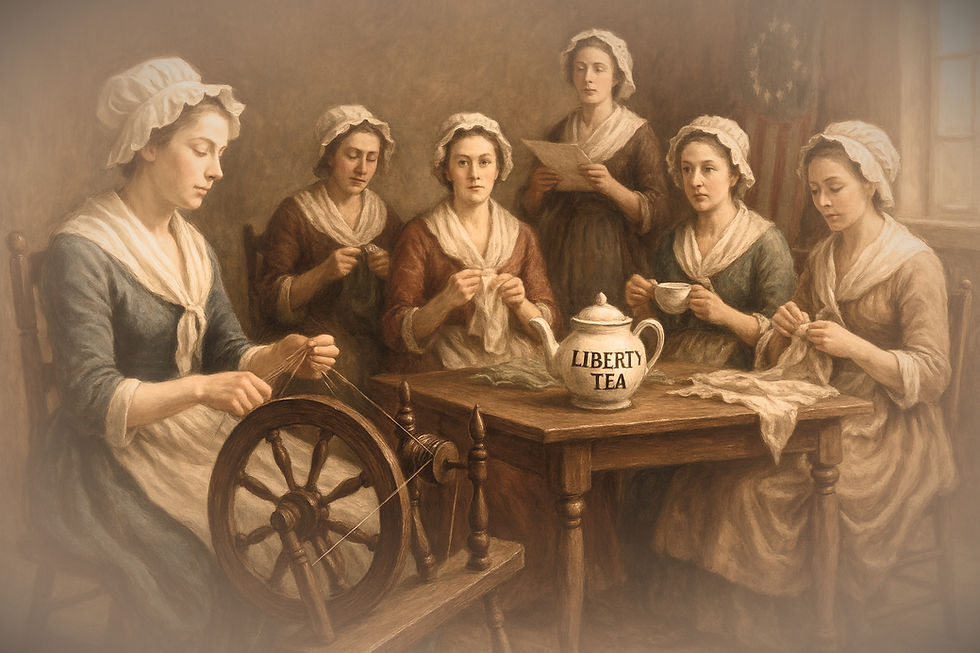
Esther proudly sent the news to General George Washington. Washington, being Washington, had opinions. He worried that giving money directly to soldiers would cause jealousy or disorder. Still, he understood how poorly supplied the troops were. Following his suggestion, the women used the funds to buy linen and sew shirts for the soldiers.
The Ladies’ Association did not operate outside the military structure; its fundraising and textile production were redirected through Continental leadership and converted into standardized clothing distributed to soldiers facing documented shortages.
So the women bought the linen and sewed the shirts — stretching every penny as only women with a mission (and six kids at home!!) can.
Her movement caught fire. Inspired by Esther’s example — and encouraged by women like Martha Washington — women in Maryland, New Jersey, and Virginia formed similar fundraising associations.
Esther may not have marched onto any battlefield, but she started a revolution of her own.
Plot Twist: Esther Saw Independence Coming Years Earlier
Here’s where things get really interesting.
Before The Sentiments of an American Woman ever hit a printing press, Esther was already politically sharp. On October 28, 1775, in a letter to her brother Dennis in England, she analyzed British policies, colonial anger, and the future of Anglo-American trade like she’d been reading congressional minutes as bedtime stories.
She described the moment as “filled with suspense and confusion” and warned, “We have a powerful enemy to contend with… everything that is dear to us is at stake.”
Then she dropped a line that could have slipped seamlessly into a Founding Father’s speech:
“I imagine we shall declare for independence, and exert our utmost to defend ourselves.”
And she wrote this months before many political leaders openly admitted that independence was inevitable. Her clarity showed she understood exactly what was happening in the world, the edge they were standing on, and what it meant for her family.
Not bad for a military wife with six children and no voting rights.
A Short Life, A Long Legacy

While her husband served as a colonel, Washington’s aide, and eventually President of Pennsylvania’s Supreme Executive Council, Esther stayed in Philadelphia to manage the household and lead one of the most ambitious women-led fundraising initiatives of the war.
Tragically, in September 1780, she died from dysentery at just 34 years old. She never saw the full impact of her work — or how her organizing became part of the broader Revolutionary memory of women’s wartime activism, charitable societies, and political movements.
After Esther’s death, Sarah Franklin Bache carried on the Ladies’ Association’s work, ensuring the project was completed.
While Elizabeth Ellet and other nineteenth-century writers celebrated Reed’s patriotism, they often framed her primarily as a supportive figure rather than as the architect of a large-scale wartime fundraising operation.
But Esther Reed was far more: a strategist, a fundraiser, a political thinker, and a woman who refused to wait for permission to help build a nation.
Why Esther Reed Still Matters
Her story reminds us that patriotism wasn’t only fought with muskets. Sometimes it was fought with textiles, bold words, and the stubborn belief that women could — and should — shape the future of a country.
Esther Reed didn’t whisper her patriotism. She printed it, organized it, showed her influence, and stitched it into every shirt that was delivered.
And maybe, just maybe, it’s time we put her back into the story as a main character.

Documenting 250 Years of Military Spouse Life.
Images
Ellet, Elizabeth F. The Women of the American Revolution. Vol. 1. New York: Baker and Scribner, 1848. Engraving of Esther de Berdt Reed. HathiTrust Digital Library, University of California.
“Esther de Berdt Reed.” Encyclopedia Virginia. Image credit: University of California via HathiTrust Digital Library.
Reed, Esther de Berdt. The Sentiments of an American Woman. Philadelphia: John Dunlap, June 10, 1780. Historical Society of Pennsylvania, Hazard Family Papers (Collection 1398).
“Mrs. Esther Reed.” The Miriam and Ira D. Wallach Division of Art, Prints and Photographs: Print Collection. New York Public Library Digital Collections.
Primary Sources
Reed, Esther de Berdt. The Sentiments of an American Woman. Philadelphia: John Dunlap, June 10, 1780. Digitized by the Library of Congress and the Museum of the American Revolution.
Reed, Esther. Letter to Dennis De Berdt. October 28, 1775.
Washington, George. Letter to Esther Reed, July 14, 1780. George Washington Papers, Series 4, General Correspondence. Manuscript Division, Library of Congress. Transcript in John C. Fitzpatrick, ed., The Writings of George Washington from the Original Manuscript Sources, 1745–1799, vol. 19 (Washington: U.S. Government Printing Office, 1937), 167.
Washington, George. Letter to Esther Reed, July 20, 1780. Founders Online. National Archives.
Washington, George. “George Washington to Major General Nathanael Greene, 20 December 1779.” Founders Online. National Archives. https://founders.archives.gov/documents/Washington/03-23-02-0501. Originally published in The Papers of George Washington, Revolutionary War Series, vol. 23, 22 October–31 December 1779, ed. William M. Ferraro (Charlottesville: University of Virginia Press, 2015), 658–660.
Washington, George. “George Washington to James Wilkinson, 19 December 1779.” Founders Online. National Archives. https://founders.archives.gov/documents/Washington/03-23-02-0498. Originally published in The Papers of George Washington, Revolutionary War Series, vol. 23, ed. William M. Ferraro (Charlottesville: University of Virginia Press, 2015), 655–656.
Secondary Sources & Biographical Overviews
American Battlefield Trust. “Esther de Berdt Reed.”
American Battlefield Trust. “The Ladies’ Association of Philadelphia.”
Encyclopedia of Greater Philadelphia. “Ladies’ Association of Philadelphia.”
Ellet, Elizabeth F. The Women of the American Revolution. 3 vols. New York: Baker and Scribner, 1848–1850.
Museum of the American Revolution. “Esther de Berdt Reed.”
Norton, Mary Beth. “The Philadelphia Ladies Association.”
Plakas, Rosemary. “Sentiments of an American Woman.”
Scholarly Studies
Arendt, Emily J. “‘Ladies Going about for Money’: Female Voluntary Associations and Civic Consciousness in the American Revolution.” Journal of the Early Republic 34 (2014).
Harkins, Kennedy. “Esther Reed’s Political Sentiments and Rhetoric During the Revolutionary War.” The Pegasus Review: UCF Undergraduate Research Journal 10, no. 1 (2018), Article 6.
Ireland, Owen. Sentiments of a British-American Woman: Esther DeBerdt Reed and the American Revolution. University Park: Pennsylvania State University Press, 2017.
Norton, Mary Beth. Liberty’s Daughters: The Revolutionary Experience of American Women, 1750–1800. Boston: Little, Brown, 1980.
Sklar, Kathryn Kish, and Gregory Duffy. “How Did the Ladies Association of Philadelphia Shape New Forms of Women’s Activism?” State University of New York at Binghamton, 2001.
Zagarri, Rosemarie. Revolutionary Backlash: Women and Politics in the Early American Republic. Philadelphia: University of Pennsylvania Press, 2007.


Comments