


Sentiments of an American Woman: Revolutionary Wives and the Birth of Political Organizing

Updated: Mar 6
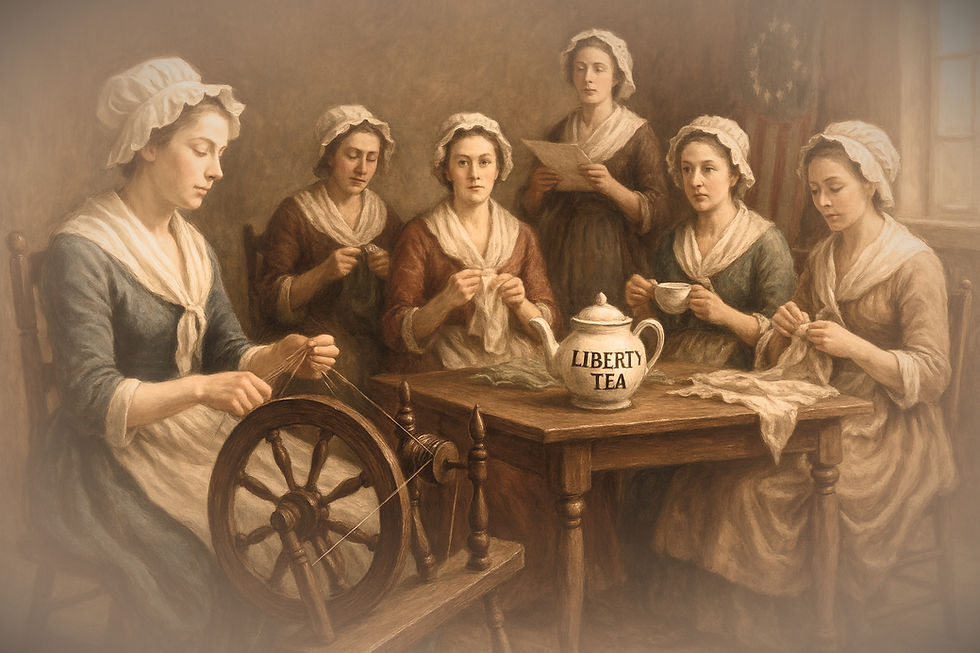
Quick note: I started writing this thinking it would be a neat little one-post. Spoiler alert: It's not. There's way too much here for a single post. Consider this Part 1 of what will likely be a mini-series. Because this isn't just history — it's the origin story of military spouse history.
So… what were Revolutionary wives actually doing?
We know the basics of the American Revolution, the powdered wigs, tea overboard, and Paul Revere galloping dramatically at midnight. But behind all the powdered and passionate patriotism were women. Especially wives, who weren't just sitting at home waiting for letters or asking permission from the battlefield. They were organizing, protesting, and quietly (or not-so-quietly) changing history.
Let's ask the fundamental questions:
What were these women thinking?
What pushed them to act?
And how did people react when they did?
(See why I cant just write one little post?)
"The war raised once again the old question of whether a woman could be a patriot—that is, an essentially political person—and it also raised the question of what form female patriotism might take."
— Linda K. Kerber (Historian & Writer )
Two Historians Walk Into a Revolution…

Mary Norton and Linda K. Kerber wrote two foundational books in 1996 on Revolutionary women (Liberty's Daughters and Women of the Republic ), and when asked how their takes differed, Norton said this:
"Kerber saw it as half empty. I saw it as half full."
Iconic. That metaphor stuck with me... not just for understanding historians' views, but for how women at the time saw their own roles. For some, the Revolution was an opening—a way to step into public life (e.g., Mercy Otis Warren). Others saw it as another moment they'd be called on to support men's movements, with no promise of equality in return. Spoiler: Both views were valid.
Some women were out there making noise. Others worked within their "acceptable" roles... spinning, sewing, boycotting, and turned those acts into pure political fire. Together, they created a version of patriotism that didn't need a musket to be revolutionary.
Here's what the history books often miss: this wasn't protest for its own sake.
Nonimportation only worked if households complied, and women controlled the household. When they refused British goods, organized spinning production, and socially enforced the boycott among their neighbors, they weren't just expressing solidarity.
They were building the supply and coordination networks that would later sustain the war itself. The spinning wheel wasn't a symbol. It was infrastructure.
Revolutionary Housewives:
They Came. They Spun...They Protested

Enter the Daughters of Liberty... think of them as the unofficial secret club of women who said,
"You know what? We can fight, too. We just don't need uniforms to do it."
They weren't out in the streets rioting (though some probably wanted to be). Instead, they used what they had, spinning wheels, teapots, and purchasing power.
They held spinning bees (yes, that's a thing), where they gathered to make homespun cloth rather than buy British imports. It was a form of protest wrapped up in domestic normalcy. And it worked.
“It worked” in the sense that it reinforced enforcement of nonimportation agreements. By publicly producing homespun cloth, women reduced dependence on British textiles, normalized compliance with the boycott, and created visible proof of collective resistance. The combination of supply substitution and reputational pressure strengthened the political cohesion required for sustained opposition.
In 1767, the Massachusetts Gazette wrote about elite women spinning together, proudly choosing American-made cloth over imported finery. In Rhode Island, women were "laudably employed" on a musical instrument called… the spinning wheel.
What About Tea? Oh, They Had Thoughts & Opinions
![Teapot with inscription, No Stamp Act [National Museum of American History. “No Stamp Act” Teapot, ca. 1766–1770. ]](https://static.wixstatic.com/media/9c2d76_9b82f36f009e4acbbf91492f9f23db20~mv2.jpg/v1/fill/w_980,h_651,al_c,q_85,usm_0.66_1.00_0.01,enc_avif,quality_auto/9c2d76_9b82f36f009e4acbbf91492f9f23db20~mv2.jpg)
A few things united colonial women, like their deep love of tea and their even deeper resentment of having to pay taxes on it (remember purchasing power). After the 1773 Tea Act, women put their cups down and said, "No thanks, King George." Instead of sipping British East India tea, they brewed "liberty tea" , made from raspberry leaves, herbs, and pure spite.
They even turned down tea at social gatherings and proudly served New England rum instead. (Clearly, these ladies knew how to host a protest… Oh, to be a fly on those walls.) And this wasn't just symbolic.
What made tea refusal so effective wasn't the gesture — it was the scale.
Households controlled daily consumption, which meant women controlled the enforcement of the boycott at the most granular level possible. Every cup of liberty tea was a small act of coordination. Multiplied across thousands of households, it pressured imperial authority in ways no single declaration could.
These small rebellions built the momentum that led to the Boston Tea Party — with Sarah Bradlee Fulton (aka the "Mother of the Boston Tea Party") reportedly suggesting the Sons of Liberty dress as Mohawk Indians to avoid detection.
Revolutionary cosplay? Absolutely (however, also offensive to the Mohawk Indians ). Sadly, Smart strategy? Also, yes.
Patriotism by Wardrobe
Let's talk fashion. Revolutionary women were no longer about imported silks and sparkly ribbons. Homespun gowns became a political statement ... one that said,
"We don't need your overpriced British lace, thank you very much."
In fact, the Virginia Gazette praised the women of Williamsburg who showed up to a ball wearing homespun. It called their outfits a shining example of "public virtue and private economy." Translation: "These ladies are stylish and revolutionary."
Some women even refused to date (or marry) men who didn't oppose British taxation. Imagine turning someone down at the local barn dance because they drank taxed tea- Iconic behavior.
Social exclusion served as an informal regulatory mechanism. By tying political loyalty to courtship, reputation, and marriage prospects, women helped embed resistance expectations within community life. This type of reputational enforcement increased the social cost of loyalism and reinforced collective discipline.
The Political Was Personal, and Domestic
What makes all of this even more incredible? These women didn't abandon their traditional roles — they expanded them. One Massachusetts woman reportedly did all the morning work of her large household, made cheese, carried her spinning wheel two miles, and spun all day before heading home to milk her cows. That's a whole protest and a workout before dinner.
They proved that political organizing could live in the kitchen, in the parlor, in the sewing circle. Their labor, choices, and refusals were as strategic as any battlefield plan.
War-making requires more than soldiers. It requires compliance, supply continuity, local production, and shared political legitimacy. The domestic organizing of Revolutionary wives contributed to those conditions before and during formal hostilities. By sustaining boycott discipline, encouraging local manufacturing, and reinforcing community alignment, women helped create a more "stable civilian base" upon which military mobilization depended.
So, What's the Legacy?
While most visible in New England and led mainly by elite white women (because they had the platform and literacy and supplies to be recorded), the Revolution also impacted enslaved women, Indigenous women, and working-class women, who made sacrifices that went largely undocumented. It is their history that truly interest me.
Although not all participants were married, the practices of organizing through household labor, consumption control, and community enforcement would later become embedded in wartime patterns among military wives specifically. The continuity is why these early actions form part of military spouse history rather than existing solely as generalized women’s political activism.
Even with those limitations, the women we can research show us how deeply they shaped the movement — using their social lives, their clothing, and even their dating standards to push back against British rule. They laid the groundwork for future political organizing, all while raising kids, running farms, and hosting spinning bees.
One writer in 1769 said it best: "There was never a time when…the Spinning wheel could more influence the affairs of men, than at present."
What's Next?
We're just getting started. Next up in this series: we'll dive into Edenton , From Edenton to Advocacy: How Military Wives Turn Visibility into Power
Stay tuned — because Revolutionary wives weren't just helpmates in petticoats. They were the architects of early American resistance and the foundation to the Continental Army.

Documenting 250 Years of Military Spouse History.
#HomefrontArchives #BehindTheUniforms#LibertyTea #HerstoryMatters #RevolutionaryWomen #MilitarySpouseHistory #DaughtersOfLiberty
P.S. Yes — all of this still resonates. (I wish I could just leave it, but I can't). Today, we still see women (military spouses) stepping up in times of uncertainty, often behind the scenes, balancing family, labor, and advocacy. Military spouses continue to organize, build networks, and speak truth to power — often without recognition.
Just like their Revolutionary foremothers, they’re expected to serve quietly while history is written loudly. Maybe it’s time we rewrite that.
Images
ScholarGPT. AI-generated image of Revolutionary women engaging in political action during the American Revolution.
National Museum of American History. “No Stamp Act” Teapot, ca. 1766–1770. Ceramic creamware teapot made in England, likely by Cockpit Hill Factory. Home and Community Life Collection. Smithsonian Institution. https://n2t.net/ark:/65665/ng49ca746a1-4e08-704b-e053-15f76fa0b4fa
Primary Sources
“Excerpt from the Virginia Gazette (December 14, 1769).” Encyclopedia Virginia. December 7, 2020. https://encyclopediavirginia.org/primary-documents/excerpt-from-the-virginia-gazette-december-14-1769/
“MHS Collections Online: The Massachusetts Gazette Extraordinary.” No. 3351, December 24, 1767. Boston: Richard Draper, 1767. 37.5 cm x 24 cm. Massachusetts Historical Society. https://www.masshist.org/database/viewer.php?item_id=256&pid=2&br=1
Massachusetts Historical Society. The Annotated Newspapers of Harbottle Dorr: The Boston-Gazette, and Country Journal, April 7, 1766. Page 378. https://www.masshist.org/database/undefined
Secondary Resources
Applewhite, Harriet Branson, and Darline Gay Levy. Women and Politics in the Age of the Democratic Revolution. Ann Arbor: University of Michigan Press, 1990.
Daughters of the American Revolution. “Searching the DAR Americana Collection and NSDAR Archives.” https://www.dar.org/archives/searching-dar-americana-collection-and-nsdar-archives
“Daughters of Liberty.” Center for Women’s History. July 3, 2020. https://womensmuseumca.org/first-in-their-field-margaret-bourke-white-2/
Egner, Kate. “The Daughters of Liberty.” American Battlefield Trust. https://www.battlefields.org/learn/articles/daughters-liberty
Gundersen, Joan R. To Be Useful to the World: Women in Revolutionary America, 1740–1790. Chapel Hill: University of North Carolina Press, 2006.
Kerber, Linda K. Women of the Republic: Intellect and Ideology in Revolutionary America. Chapel Hill: University of North Carolina Press, 1996.
Norton, Mary Beth. Liberty’s Daughters: The Revolutionary Experience of American Women, 1750–1800: With a New Preface. Ithaca: Cornell University Press, 1996.
Ramsbey, Thomas W. “The Sons of Liberty: The Early Inter-Colonial Organization.” International Review of Modern Sociology 17, no. 2 (1987).
“Women in the 16th, 17th, and 18th Centuries: Introduction.” Feminism in Literature: A Gale Critical Companion. Encyclopedia.com.


Comments