


Holding the Line: Military Wives from Vietnam to Today

“Early in your new role as an Army wife, you must understand that your husband’s ‘duty’ will come first — before you, before your children, before his parents, and before his personal desires and ambitions.”
— Nancy Shea and Anna Perle Smith, The Army Wife (Harper & Row, 1966)
After military retirement in 2021, in April 2023, I wrote the first version of this as an academic paper on Vietnam-era military wives (1964–1973). I didn’t expect it to hit me in the chest.
Reading the oral histories, I cried — not a polite, single-tear situation, but the kind of cry that catches you off guard, and makes you feel a little ridiculous even when no one’s watching. The women’s voices struck a familiar chord: isolation, all the unwritten expectations, the constant pressure to keep everything together while the country (and sometimes your own family and friends) argued about whether the war was worth it.
Different wars, different decades, same architecture.
Then I got angry.
(I was surprised by how much this topic triggered me.)
Here’s what I kept running into: Vietnam-era military wives were never “outside” the war. They were fighting a parallel campaign from the home front — under expectations the military rarely put in writing but absolutely enforced — while the country turned against the very thing their husbands were doing.
And Vietnam wasn’t some weird one-off.
I kept seeing the same pattern in Iraq. Afghanistan. Across branches. Once you see it, you can’t unsee it. And honestly? It’s a little sickening how often it repeats.
The War That Happened in Living Rooms

Historian Andrew Wiest spent years interviewing Vietnam veterans and their wives for Charlie Company’s Journey Home (2019). At some point in that process, he realized he’d been missing a major part of the story:
“It began to dawn on me [Wiest] that in measures great and small, the Vietnam War was the unrelenting force that had crafted the landscapes of these women’s adult lives. They had not fought in the steaming rice paddies, but they were veterans of the war in their own right.”
He’s right. And you don’t need a policy document or an official record to see it — the oral histories do the work all on their own.

From Charlotte McDaniel’s Stories Untold: Oral Histories of Wives of Vietnam Servicemen (2019):
Susan, Air Force enlisted wife: “It was a different expectation for us [military wives]. When he was gone, I was in charge of everything — money, living quarters, bills, whatever came up. It was not easy.”
Linda, wife of an Air Force flight surgeon: “We wives assumed responsibilities at home after our husbands deployed that the husbands would typically take on… Yeah, I did have a terrible experience. There’s nobody that realized, I mean, you’re alone. You don’t have anyone on the base to back you up because you can’t stay on the base once your husband’s gone. No backing whatsoever. Gone. Isolated. Alone.”

Linda Moore-Lanning, Waiting: One Wife’s Year of the Vietnam War (2009): “My alienation was complete… I lived in a world apart, apart from them, apart from Lee [husband], apart from Vietnam, apart from everything, and every home I’ve ever known. The only thing I had to hold onto was my sanity, and my tenuous grasp on it seemed tethered by a thin and fragile thread, indeed.”
Brown's PhD dissertation quotes , Sybil Stockdale, founder of the POW/MIA wives’ organization: “Wives received little support in maintaining a stolid personality. When wives turned to military chaplains, they sent them to doctors who prescribed tranquilizers to control anxieties.”
I’ve met Vietnam-era spouses through my work. Many still won’t talk about that time. The veterans will sometimes go there, but the wives often say something like, “It was hard, but it’s over, and he made it home.”
When they find out I’m a military wife from the Iraq and Afghanistan era, though, there’s usually this quiet recognition — like, oh, you get it. We end up swapping stories that sound different on the surface but rhyme beneath the surface.
That’s not unusual. Some things don’t get easier with time — they just get quieter.
I also avoid recounting our deployments. Instead, I picture each one as a box on a shelf: done, put away, keep moving. Is that healthy? Maybe not. But it works for now. And over the years, I’ve learned most people don’t actually want to hear about it anyway.
What the Handbooks Actually Said
Even when the military didn’t spell it out in formal regulations, the expectations were there.
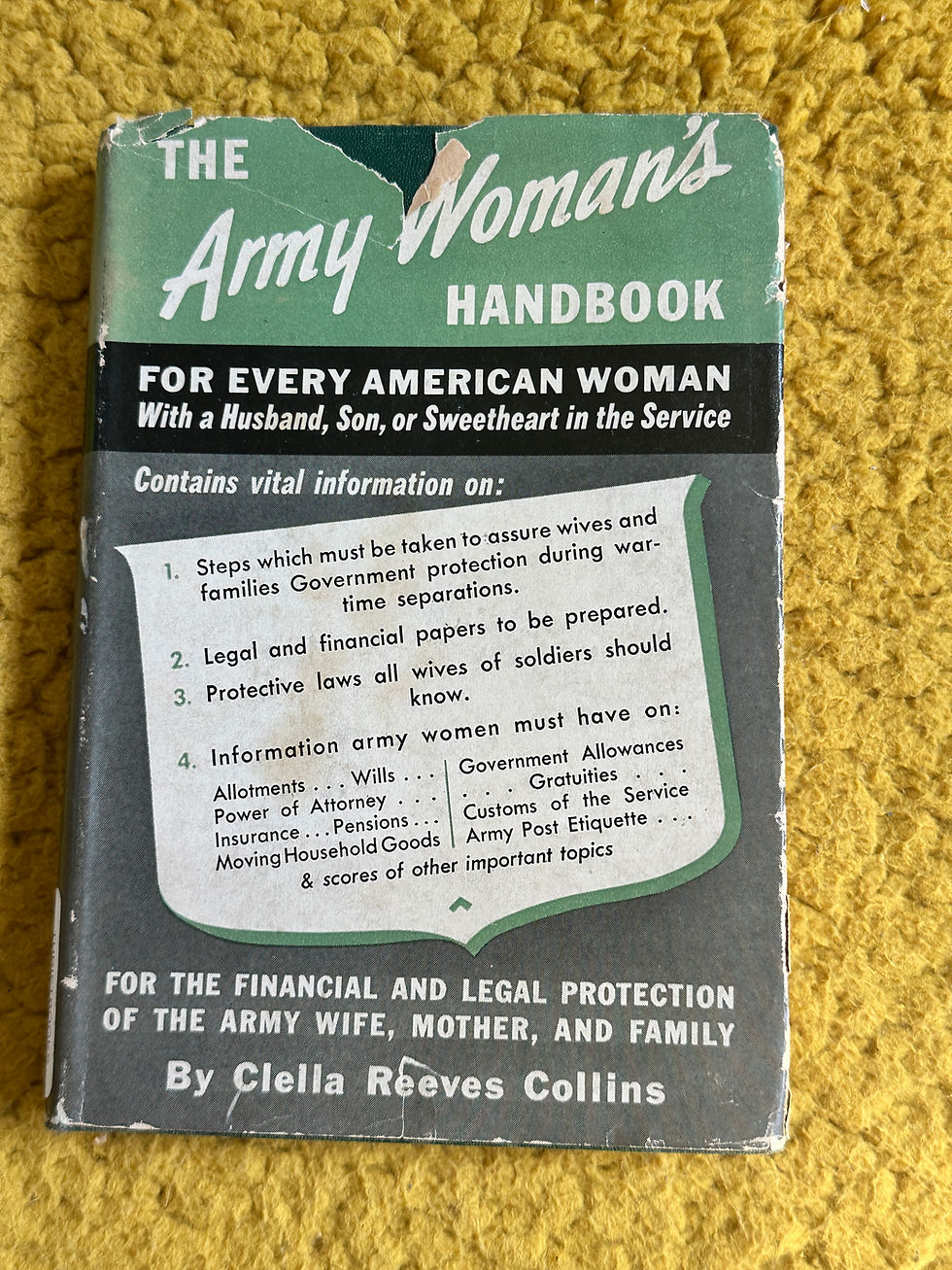
Guidebooks, handbooks, and plain old tradition assumed wives would keep morale up, support the community, and represent the service in public. And everyone understood the unspoken part: a wife’s behavior could affect her husband’s career. That wasn’t always written down in a neat bullet list, but it was enforced through command expectations, community pressure, and the “way things are” at every level of military life — from officer housing to enlisted quarters.
There were a lot of these handbooks. If I catalogued every one I have, I’d either bore you or enrage you… possibly both.
What stopped me cold, over and over, was how familiar so many of the “1960s–70s problems” sounded. The specifics changed. The structure didn’t.

Heath Hardage Lee’s The League of Wives (2019) shows what happened when wives decided the usual handbook rules no longer applied. A small group organized to advocate for POW/MIA husbands — pushing the U.S. government and the military establishment directly and going public when they were told to stay quiet.
What I appreciate about Lee’s approach is that she doesn’t frame these women as background characters doing “devoted wife” things. She treats them as people who created institutional change from the inside of a system that hadn’t exactly invited them to do that.
Elizabeth Brown’s dissertation, Bye Bye Miss American Pie (2005), maps what was happening outside the gate while military culture barely budged: the women’s movement, civil rights, the whole country renegotiating what marriage and work were supposed to look like.
The wives were living inside all of it and inside the military at the same time.
(Isn’t that still the truth?)
When the Country Turned Against the War
By the mid-1960s, military families were living in a country that had started asking whether the war was worth fighting at all. Anti-war protests. Declining trust in government. Open criticism of the military.
Meanwhile, wives were still expected to support their husbands’ service — often in communities where that service was being questioned or opposed.
The isolation wasn’t only physical. It was social.
Race and class shaped these experiences unevenly. Not all military wives ( and husbands) lived the same life. Access to housing, support networks, and opportunity depended on rank, income, and where you were assigned.
Families on isolated bases or stationed overseas often felt the separation most sharply. Those wives became the main source of stability: managing finances, raising children, building community, and making major household decisions while their husbands were serving far away.
Some wives moved from private endurance into public action. They spoke to the media, challenged policy, and organized politically to demand answers about prisoners of war and missing service members. Lee documented that story in detail.
And what it shows is this: military wives weren’t only sustaining the home front. In some cases, they pushed issues into public view strongly enough that the military and the government were forced to respond — even when institutional channels were closed to them.
That influence continues today. Spouses still advocate (often behind the scenes), and most people never realize a military spouse is behind the work.
And here’s the bigger point: the military has never been only a fighting force. It has always depended on households, relationships, and unwritten systems that help the institution function — especially during long wars, when the official structure alone isn’t enough.
What the Military Eventually Admitted
By the end of the war, Vietnam-era military wives had exposed problems the institution couldn’t keep brushing off.

In 1983, Army Chief of Staff General John A. Wickham Jr. issued The Army Family: A White Paper, a report on the changing relationship between the Army and military families from 1775 to 1983. Drawing on demographic data, trend analysis, and interviews conducted between 1979 and 1982, the report concluded that the Army had serious flaws in its care for soldiers, spouses, and dependents.
None of this was new. The surveys were just finally putting numbers to what military families had been living with for years.
Vietnam didn’t create these problems — it broke them open.
And once the all-volunteer force was in place, the Army couldn’t pretend family life was “extra” anymore. If the Army actually needed people to stay, it needed their families to be able to survive this military life. Suddenly, retention was personal. (Hmm, “all in” philosophy — IYKYK )
What stands out in the White Paper is that it reads less like routine policy language and more like an institutional acknowledgment of problems the Army had long depended on families to absorb.
For the first time, the Army put in writing what military wives had known for generations: the institution had failed families in measurable, documented ways.
Wickham named the Army’s historical posture plainly, acknowledging the shift from what he called “studied neglect,” through “ambivalent and selective inclusion of families in the military community,” to finally recognizing family support as an institutional imperative.
That language — coming from the Army’s highest uniformed officer — mattered. This Mattered. It meant the experiences Vietnam-era wives had endured in silence were now on the record.
The paper also introduced what became one of the most quoted principles in military family policy: the Army recruits individuals but retains families.
Seven words that reframed the entire relationship.
A soldier’s decision to stay in service was no longer just his — it was his family’s. That acknowledgment (however overdue) laid the groundwork for family readiness groups, Army Community Service, spouse employment programs, childcare infrastructure, and financial counseling.
The Army Family Action Plan, launched directly from the White Paper, produced nearly 200 new programs in its first decade alone.
It took a war that broke something open — and then a decade of quiet pressure from the families who lived through it — to get the institution to produce pages of honesty. That’s worth naming.
Wickham also acknowledged that the civil rights movement, women’s activism, and broader social change had forced the Army to reconsider long-standing assumptions about family roles.
Historian John Worsencroft argued that the 1983 White Paper marked a fundamental shift in how the Army understood the relationship between the institution and the family — recognizing that family stability directly affected morale, readiness, and retention.
In the decades that followed, similar concerns showed up across the other services as the Department of Defense expanded family support programs, readiness groups, and quality-of-life initiatives first developed during the post-Vietnam years.
The Army returned to the issue again in 2003 (this is my era), when a new Army Family White Paper built on the same concerns first identified in 1983: showing how long the lessons of Vietnam continued to shape military policy.
Programs that later became standard — family support services, spouse organizations, and formal recognition of military family contributions — grew out of problems that became impossible to ignore during the Vietnam War.

You would think problems solved! Sounds great! (And I can tell you from my own era — better than Vietnam, yes. But not loads better.)
But policies and policy changes don’t work like that. It’s all about funding, manning, and leadership– it needs backing. It took decades. Many of those lessons are still being learned, studied, and worked out in 2026.
And if you’ve navigated PCS moves, deployments, EFMP referrals, OMG– Tricare, or tried to find childcare or employment on post in the last five years, you already know that.
The history of the Vietnam War is not only a history of combat, drafts, and politics. It is also a history of the home front — of spouses whose labor and endurance sustained military service through one of its most difficult and divisive periods.
Their experiences exposed institutional weaknesses that shaped every military family support system that came after.
The war happened on two fronts. One of them has been documented extensively. The other one is what this archive is for.
My focus here is on wives because that’s where the historical record is. The near-total absence of documentation about military husbands who supported active-duty wives remains a gap that needs to be filled — then and now. But the pattern applies regardless of gender: spouses carried responsibilities and strain that sustained military service, even when the country turned against the war itself.

~Mel
#MilitarySpouseHistory #HomefrontArchives #BehindTheUniforms #MilitaryHistory #HomeFrontHistory #HomeFrontAsInstitution #WarBeyondTheBattlefield #MilitaryFamilySystems
———
Further Reading
Vietnam-era military wives:
Wiest, Andrew. Charlie Company’s Journey Home: The Forgotten Impact on the Wives of Vietnam Veterans. Bloomsbury Publishing, 2019.
McDaniel, Charlotte. Stories Untold: Oral Histories of Wives of Vietnam Servicemen. KEK Publishing, 2019.
Moore-Lanning, Linda. Waiting: One Wife’s Year of the Vietnam War. Texas A&M University Press, 2009.
Lee, Heath Hardage. The League of Wives: The Untold Story of the Women Who Took on the U.S. Government to Bring Their Husbands Home. St. Martin’s Press, 2019.
On military wife culture and institutional expectations:
Shea, Nancy, and Anna Perle Smith. The Army Wife. 4th ed. Harper & Row, 1966.
Collins, Clella Reeves. Army Woman’s Handbook. Whittlesey House, 1942.
Alt, Betty Sowers, and Bonnie Domrose Stone. Campfollowing: A History of the Military Wife. Greenwood Publishing Group, 1991.
Primary sources (both publicly available):
Wickham, John A. White Paper 1983: The Army Family. Department of the Army, 1983.
Shinseki, Eric K. The Army Family: A White Paper. Department of the Army, 2003.
![Same Ocean, Different Boats (and Aircraft) [Created by Homefront Archives.]](https://static.wixstatic.com/media/9c2d76_01060392a5c04588b588a431cef87a39~mv2.png/v1/fill/w_980,h_653,al_c,q_90,usm_0.66_1.00_0.01,enc_avif,quality_auto/9c2d76_01060392a5c04588b588a431cef87a39~mv2.png)

Comments